TL;DR
- Chrome’s Local Network Access (LNA) blocks web pages from quietly reaching services on your
machine or LAN, but by design it does not cover top-level navigations. Combined with DNS
rebinding, a page can open a popup that becomes a
127.0.0.1page and read a loopback-only service. This is publicly known (Chromium issue 475274565, January 2026) and documented by Google. I didn’t find it; I reproduced it in an isolated lab to see what a defender can detect. - It worked on Chrome 155 with LNA in blocking mode. A small server-side check, validating the
Hostheader, stopped the theft completely without changing a single packet on the wire. - The network sees the setup (a DNS answer flipping from the attacker’s address to
127.0.0.1) and the consequence (data leaving in a long URL), but never the theft itself, which happens entirely on the victim’s loopback interface. - Suricata (ET Open) had no signature for any of it. My custom Zeek detector did better, but its stateful alerts fired on only 1 of 10 attempts: Security Onion runs Zeek as several worker processes, and the detector’s memory was split between them. Nothing errored. It just fired less.
Background
DNS rebinding in one paragraph
Browsers enforce the same-origin policy by name, not by IP address. If rebind.lab first
resolves to the attacker’s server, the attacker’s page loads normally. If the attacker’s DNS server
then starts answering 127.0.0.1 with a 1-second TTL, the same origin (http://rebind.lab:8080)
now points at the victim’s own machine. Anything listening on 127.0.0.1:8080, such as a dev server,
a local admin panel, or a desktop app’s API, is suddenly “same-origin” with the attacker’s page. The
technique is old; NCC Group’s Singularity of Origin and
State of DNS Rebinding in 2023
are good background.
Chrome’s Local Network Access, and its documented gap
Local Network Access is
Chrome’s defence: requests from a public page to a more private address space (LAN or loopback) need
a permission, and in blocking mode they simply fail. It checks the IP address it actually connects
to, so rebinding a subresource request (fetch, img, iframe) to 127.0.0.1 gets blocked.
But LNA’s scope is explicit about what it doesn’t cover:
- The spec: “Chromium only applies LNA restrictions to iframe navigations currently. It may be worth expanding this to include main-frame navigations (especially popup windows which can be controlled by their opener).” (spec issue note)
- Chrome 147 release notes: “Chrome does not currently enforce any LNA restrictions on main frame navigations.” (release notes)
- Chromium engineers on enforcing it for navigations: no timeline, because it breaks real sign-in flows. (WICG/local-network-access#48)
A popup is a main-frame navigation. After the rebind, the popup’s document is served from
127.0.0.1, so its own requests to 127.0.0.1 are loopback-to-loopback, which isn’t an LNA
request at all. And because it’s same-origin with the page that opened it, that page can script it.
The full chain was reported publicly in
Chromium issue 475274565 (January 2026), with a
proof of concept. This post adds the defender’s half.
The lab
Everything ran in an isolated detection range on my own hardware: no route to the internet or my home network, every system mine. Traffic between the range’s VLANs is routed by a pfSense firewall, and every VM’s network port is mirrored to a Security Onion 2.4.211 sensor running Zeek and Suricata. Anything that tries to reach “the internet” is answered by an INetSim sinkhole.
| Role | System | Address |
|---|---|---|
| Victim | Ubuntu 24.04, Google Chrome 155.0.8059.39 (stable channel) | 10.10.41.106 (victim VLAN) |
| Target | A deliberately weak “admin panel” on the victim, loopback only (127.0.0.1:8080), serving a canary secret | — |
| Attacker | Kali; DNS server for the lab zone + web server + data collector | 10.10.42.30 (attacker VLAN) |
| Sensor | Security Onion: Zeek (3 workers) + Suricata (ET Open) + full packet capture | mirrors both VLANs |
Browser settings, stated plainly because they matter:
- LNA enabled in blocking mode. Every run included a control request (a normal
fetchfrom the attacker page to loopback) that LNA had to refuse. It did, every time, so LNA was demonstrably on. - Address-space override: the attacker’s address was labelled public (
--ip-address-space-overrides), so the jump is the canonical public → loopback case. Without it the attacker sits in private space (local → loopback), which LNA also gates. - Popup blocker disabled (
--disable-popup-blocking), because the victim browser was driven by Playwright with no human to click. In a default browser this chain needs one user click to open the popup. Nothing here gets around that.
The experiment: two runs, one difference
| Run 1 | Run 2 (control) | |
|---|---|---|
| Target service | accepts any Host header | rejects requests whose Host isn’t localhost/127.0.0.1 |
| Result | secret read and exfiltrated | read refused (403), nothing of value sent |
The chain, stage by stage (times from the sensor, UTC−4 as in the screenshots):
| # | Stage | Run 1 | What the network shows |
|---|---|---|---|
| 1 | Victim loads the attacker page; rebind.lab → 10.10.42.30 | 16:26:27 | DNS answer, HTTP page load |
| 2 | The page tells the attacker’s DNS server to switch rebind.lab to 127.0.0.1 (TTL 1 s) | 16:26:27 | a small HTTP request to the attacker’s collector |
| 3 | Wait out Chrome’s DNS cache | 66 s | nothing |
| 4 | Popup navigates to rebind.lab; Chrome re-resolves it and gets 127.0.0.1 | 16:27:33 | DNS answer to loopback |
| 5 | The popup’s own document reads the local service | 16:27:33 | nothing (loopback) |
| 6 | Data sent to the attacker’s collector in a long URL | 16:27:33 | HTTP request with a 667-byte URL |
Run 2 (16:46–16:47) produced the identical sequence on the wire. The only difference was a 403 inside the victim, which the network can’t see.
What the network saw
The DNS flip is the clearest network evidence: one name, two answers, 66 seconds apart, the second pointing at the victim’s own loopback address with a 1-second TTL.
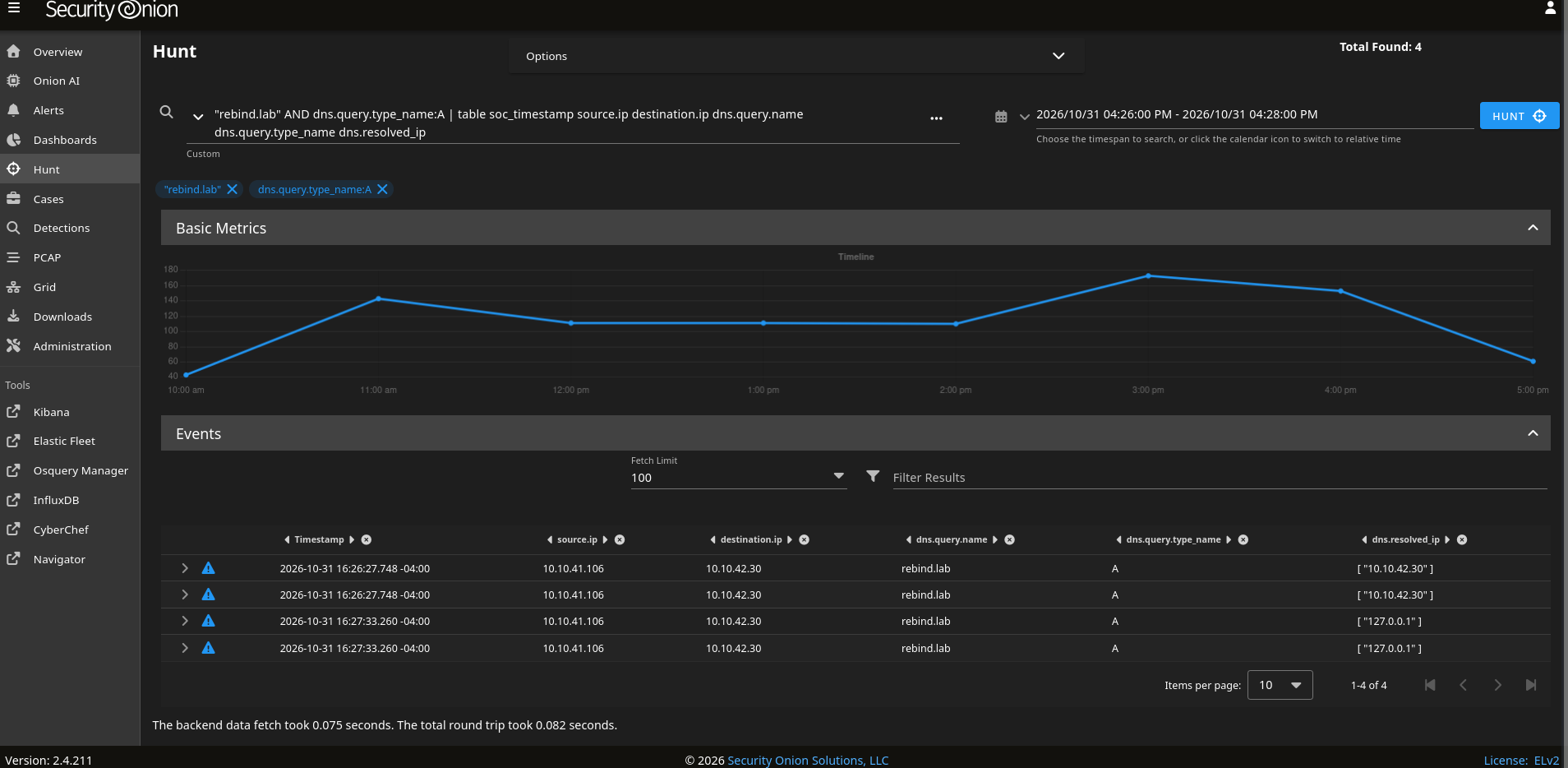 Each answer appears twice: the sensor sees the routed packet at both the victim’s and the attacker’s
port. Same transaction, same Zeek uid.
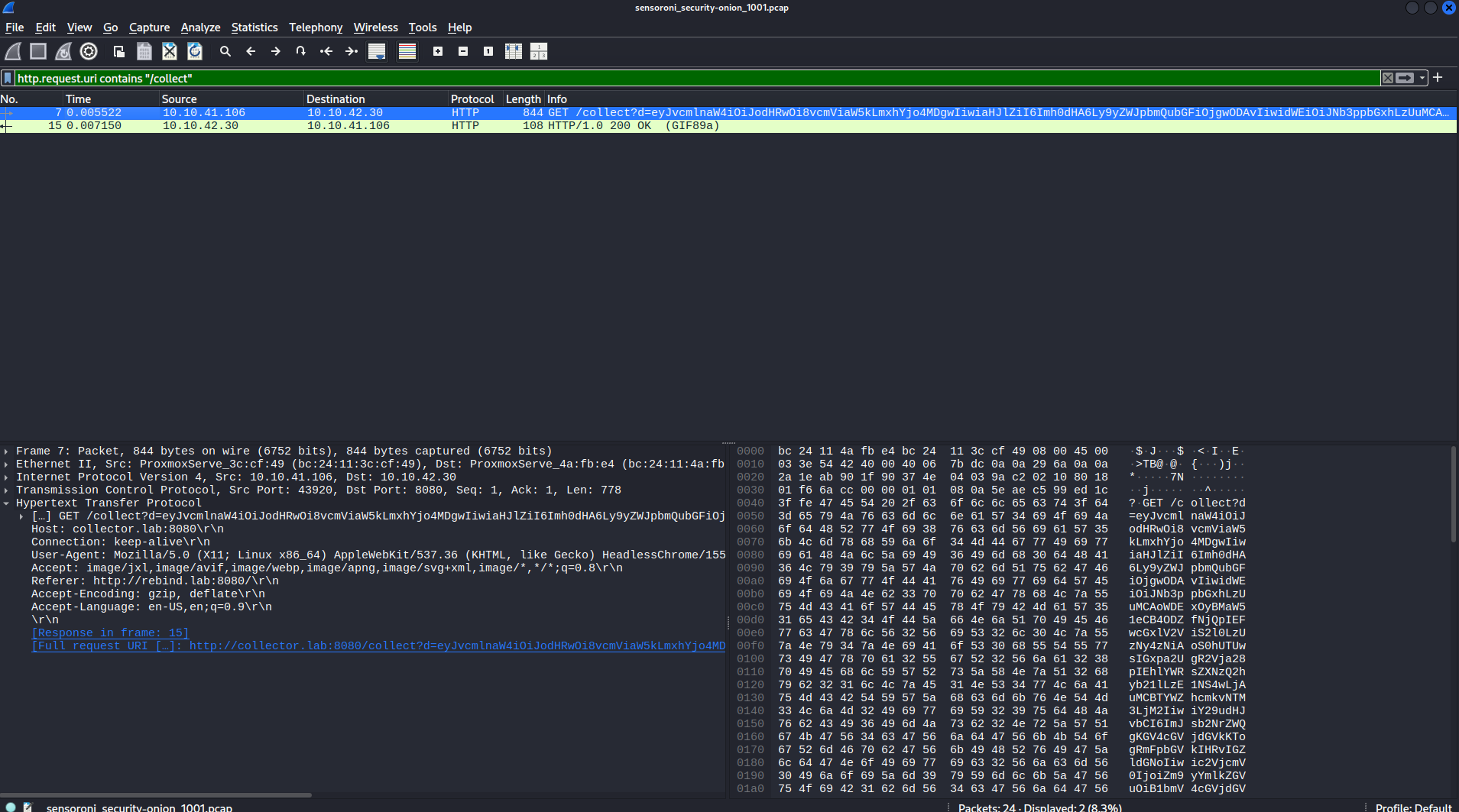
The exfil arrives at the attacker’s collector as a GET with a long, encoded query string. Full packet capture shows the request on the wire, along with the referrer giving away the rebound page:
 Run 2 (control): the beacon still fires; the secret field is empty because the read was refused.
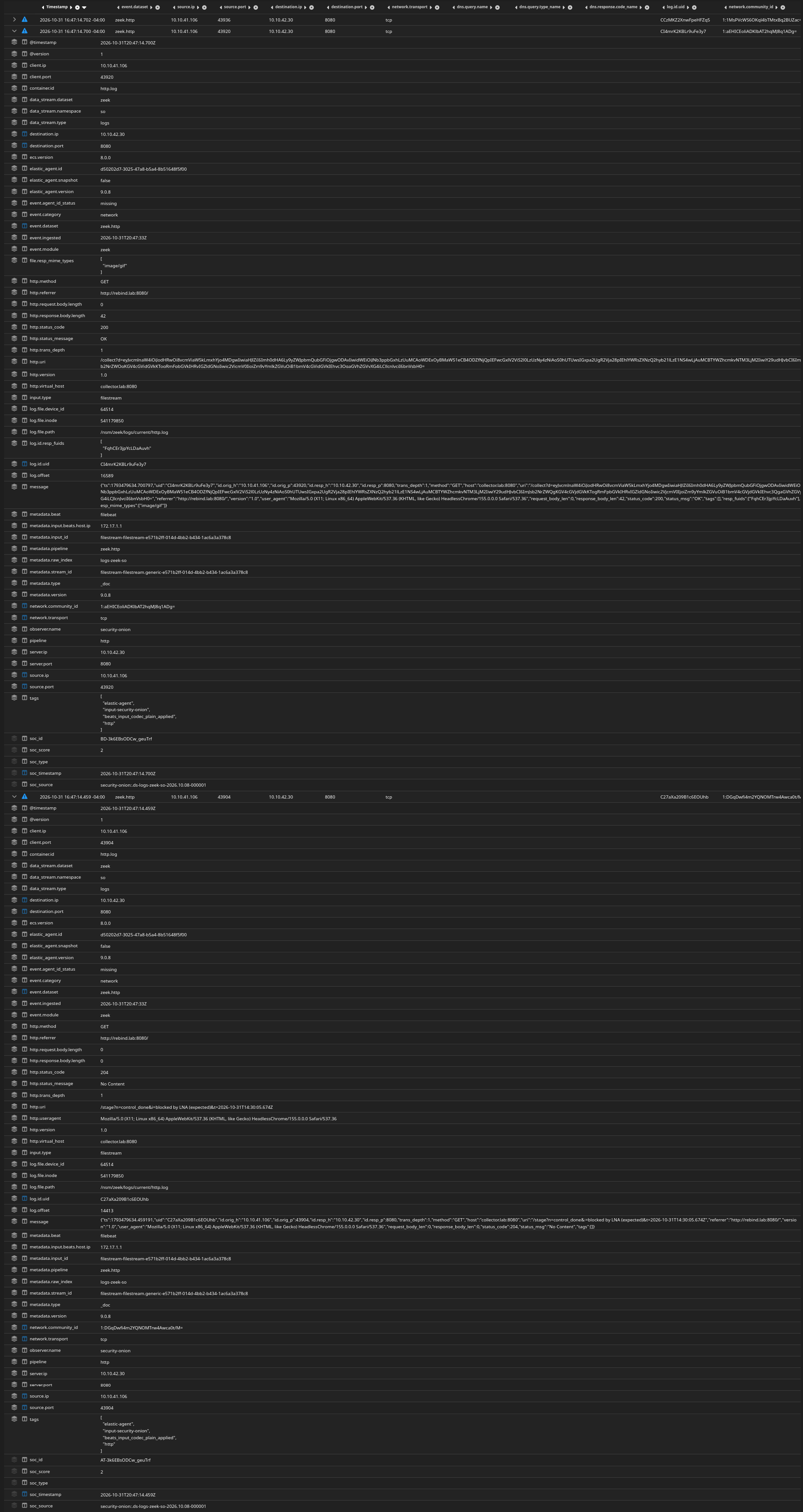 The
/stage?s=control_done…blocked by LNA (expected) request is the control check reporting
that LNA blocked the direct fetch. Its embedded timestamp (14:30Z) is the victim’s clock, hours
behind the sensor’s (20:47Z); more on that under Limitations.
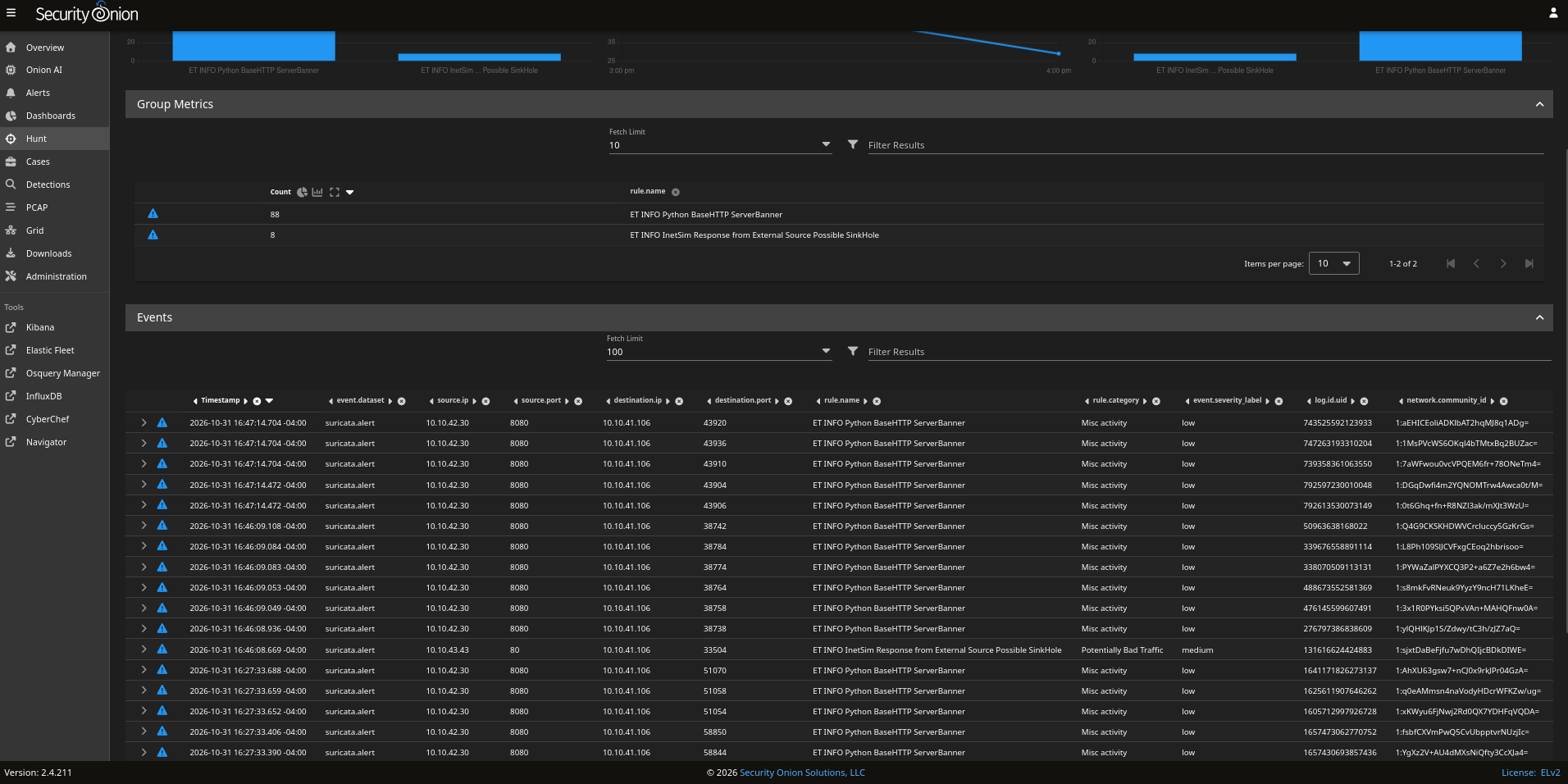
Suricata had nothing. Across the evening’s attempts it raised two signatures: one for the attacker’s Python web-server banner, which is an artifact of my tooling, not the technique, and one for the INetSim sinkhole. No ET Open rule describes DNS rebinding or this exfil pattern.
What the network could not see
The theft itself is invisible to a network sensor. Stages 4 and 5 happen on the victim’s
loopback interface; no packet ever crosses a wire the sensor watches. I could only prove the read
happened from the host: the target service’s own request log (Host: rebind.lab, /secret,
200 in Run 1 and 403 in Run 2) and a packet capture taken on the victim’s lo interface.
That’s the core finding: network monitoring sees the bookends of this attack, never the act.
A real local service usually doesn’t log the Host header it was called with, so on most machines
the middle of this story would be gone entirely. That’s the case for endpoint telemetry on the hosts
that run local services.
Detection: a Zeek detector that caught 1 attempt in 10
I wrote a small Zeek script with three notices:
| Notice | Fires when |
|---|---|
DNSRebind::Loopback_Answer | a non-local name resolves to a loopback address |
DNSRebind::Rebind_Flip | a name’s answer moves from a public/external address to loopback or private space |
DNSRebind::Exfil_After_Rebind | a client sends a URL ≥ 200 bytes within 10 minutes of seeing a flip |
The core is short:
# excerpt: helper functions and constants (loopback_nets, private_nets, long_uri = 200,
# watch_window = 10 min) omitted
global last_answer: table[string] of addr &create_expire = 10 min;
global rebound: table[addr] of string &create_expire = watch_window;

function check_answer(c: connection, name: string, a: addr, ttl: interval)
    {
    if ( is_internal_name(name) ) return;
    local is_lo = in_set(a, loopback_nets);
    if ( is_lo )
        NOTICE([$note=Loopback_Answer, $conn=c, $sub=name, $identifier=cat(name, a),
                $msg=fmt("%s resolved to %s (TTL %s)", name, a, ttl)]);
    if ( name in last_answer && last_answer[name] != a )
        {
        local old = last_answer[name];
        if ( is_lo || ( in_set(a, private_nets) && ! (in_set(old, loopback_nets) || in_set(old, private_nets)) ) )
            {
            NOTICE([$note=Rebind_Flip, $conn=c, $sub=name, $identifier=cat(name, old, a),
                    $msg=fmt("%s rebound from %s to %s (TTL %s)", name, old, a, ttl)]);
            rebound[c$id$orig_h] = name;
            }
        }
    last_answer[name] = a;
    }

event http_request(c: connection, method: string, original_URI: string,
                   unescaped_URI: string, version: string)
    {
    local client = c$id$orig_h;
    if ( client !in rebound || |original_URI| < long_uri ) return;
    NOTICE([$note=Exfil_After_Rebind, $conn=c, $sub=rebound[client],
            $identifier=cat(client, c$id$resp_h),
            $msg=fmt("%s sent a %d-byte URI to %s within %s of a DNS rebind of %s",
                     client, |original_URI|, c$id$resp_h, watch_window, rebound[client])]);
    }
Here’s everything it raised that day:
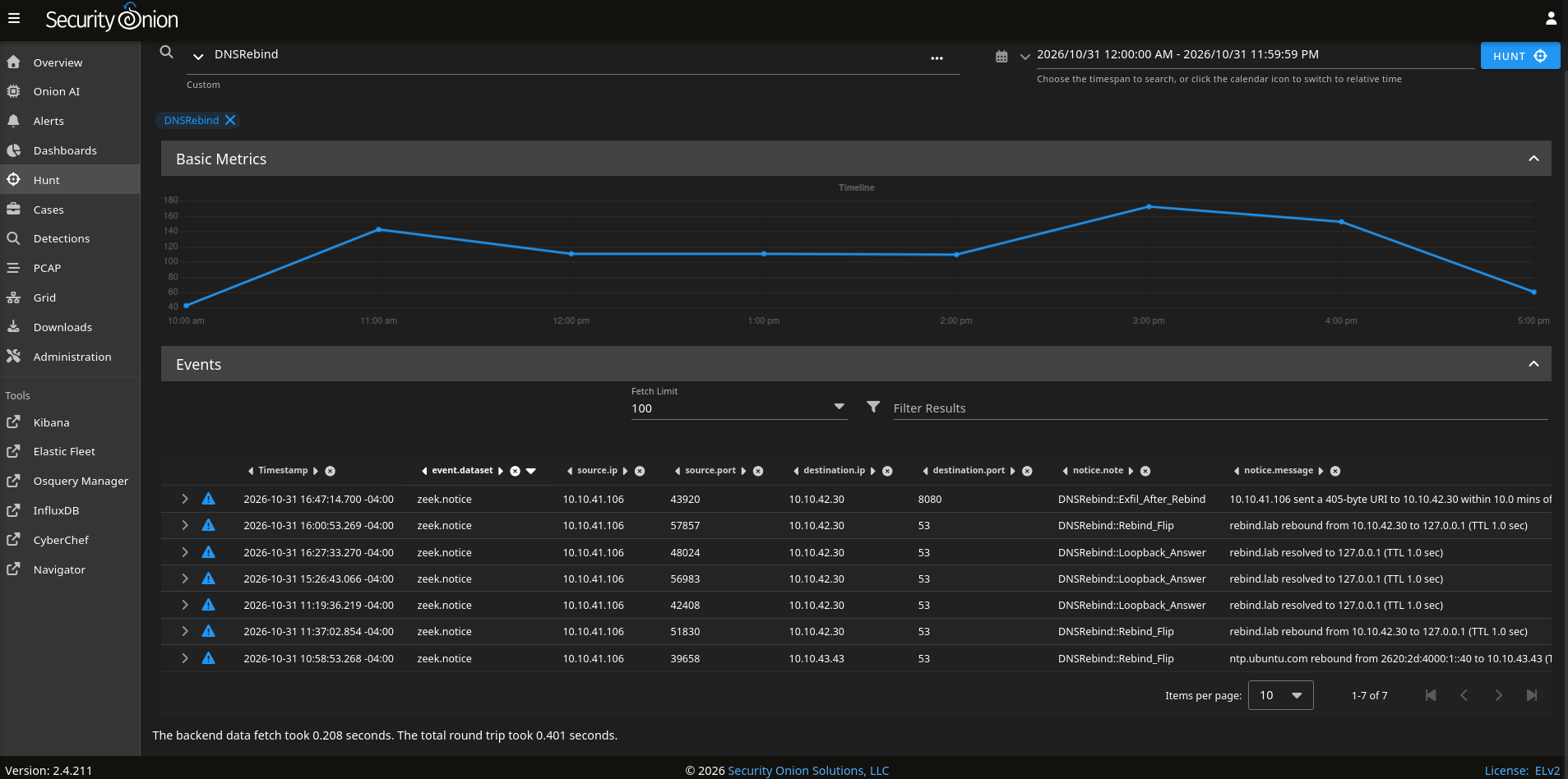
Ten attempts reached the exfil step that day: two morning trial runs, six while I debugged my
tooling, then Run 1 and Run 2. One produced Exfil_After_Rebind, and it was Run 2, the
failed theft:

That’s a nice result for the “detect the attempt, not the success” argument. But Run 1, the successful theft, was missed. Two things explain the misses.
1. Zeek runs as a cluster, and the detector’s memory didn’t. Security Onion runs Zeek with three
worker processes, and each network flow is hashed to one of them. Every DNS lookup is its own flow,
and so is the exfil connection. The detector keeps last_answer and rebound in ordinary globals,
which on a cluster are per worker:
| Notice | Needs on one worker | Expected (3 workers) | Observed |
|---|---|---|---|
Loopback_Answer | one DNS answer | always | every time it wasn’t suppressed |
Rebind_Flip | both DNS answers | ~1 in 3 | 2 logged |
Exfil_After_Rebind | both answers + the exfil | ~1 in 9 | 1 in 10 |
The notices came from all three workers, exactly as independent hashing predicts. In one morning attempt, a flip notice and an exfil request happened in the same second with no exfil notice: they were on different workers. The script worked in single-process testing; the deployment topology broke it. Nothing errored. It just fired less, silently.
2. Notice suppression. Zeek suppresses repeats of the same notice identifier for an hour by default. That’s right in production (one alert per incident, not one per page load) but it hid most of my back-to-back lab runs.
Two smaller things worth knowing:
- A false positive fired when the victim, briefly on a network with real DNS for a software
install, came back behind the sinkhole:
ntp.ubuntu.com“rebound” from a real IPv6 address to the sinkhole’s private one. Sinkholes and split-horizon DNS look like rebinding to this logic, so allow-list them. - Every DNS transaction was logged twice, because the sensor sees routed traffic at both ends.
Count DNS events by Zeek
uid, not by row.
If you run Security Onion, this finds the most reliable signal, a non-local name answering loopback, without any custom script (field names from SO 2.4):
event.dataset:zeek.dns AND dns.resolved_ip:"127.0.0.1" AND NOT dns.query.name:*localhost*
On my sensor, over the day of the runs, it returns exactly the 22 records of the 11 loopback answers (each logged twice) and nothing else.
Defences
If you build local services (dev servers, desktop-app APIs, local admin panels), this is the fix that matters:
- Validate the
Hostheader. A rebound request arrives with the attacker’s hostname, notlocalhost. Rejecting it is what turned Run 1 into Run 2: same attack, same packets, nothing stolen. - Authenticate local endpoints. “Only reachable from loopback” is not an authorization boundary.
- Don’t serve secrets over plain unauthenticated HTTP on loopback.
If you run networks:
- Turn on rebind protection in your resolver (
dnsmasq --stop-dns-rebind, or the equivalent private-address filtering in Unbound and similar). It drops answers that map external names to private or loopback space. I left it off in the lab on purpose; it’s the control this attack depends on bypassing. - Alert on loopback answers for non-local names. It’s stateless, rare, and reliable on any topology.
If you write detections:
- Test on the deployment topology, not a standalone Zeek. Stateful logic needs cluster-aware
state: forward the small events to one node (e.g.
Cluster::publish_hrwkeyed on the client), or do the correlation in the SIEM. - Mind suppression and duplicates when you measure detection rates in a lab.
And keep LNA on. It did its job on every subresource request; the gap is a documented scope decision, not a failure of what it does cover.
Limitations
- Popup blocker disabled in the lab; real-world use needs one user click — but not an
“allow popups?” prompt the victim knowingly approves.
window.openonly escapes the blocker within a few seconds of a click, and the read happens ~65 s later, so a real attacker opens the window on an incidental click (a “play”/“continue”/fake-captcha) and re-navigates it after the rebind — the known pop-under pattern. There is no iframe variant that drops the click: Chromium already applies LNA to iframe navigations, and only main-frame navigations (popups) are exempt — that asymmetry is the gap itself (see Chrome’s Local Network Access, and its documented gap, above). So the single click is load-bearing. - The attacker was relabelled as public via a Chrome override (the private-to-loopback case also applies).
- Plain HTTP and GET-based exfil. A POST body, many short requests, or DNS-based exfil would slip past the length-based exfil rule; DNS-over-HTTPS would hide the flip from the sensor entirely.
- VM clocks drifted. The victim and attacker VMs reset their clocks on every snapshot restore, so their timestamps run hours behind; everything here is anchored to the sensor’s clock.
- No endpoint telemetry on the victim yet, which is precisely the gap this experiment exposed.
Disclosure and credit
This is a known, publicly documented limitation, not a new vulnerability. The chain was reported publicly in Chromium issue 475274565 by Bhavya Gupta (January 2026), and Google documents the main-frame scope in the LNA spec and Chrome 147 release notes. All testing was done on systems I own, in an isolated lab. I’m not publishing attacker tooling; the public issue already contains a proof of concept, and this post is about detection.
What’s next
EXP-001b: fix the detector so its state survives a Zeek cluster, re-run both runs, and see whether all three notices fire every time.
References
- Chromium issue 475274565: LNA Blocking bypassable by opening a new window with DNS rebinding
- WICG: Local Network Access spec and explainer
- WICG: local-network-access#48, main-frame navigations
- Chrome: Chrome 147 release notes
- NCC Group: State of DNS Rebinding in 2023 and Singularity of Origin (background on rebinding)
- Security Onion: documentation